The Secret of Invincibility: How Did a Roman Legion Really Fight?
Was it merely the sheer mass of soldiers? Better weapons? Brilliant commanders? The answer, as so often in history, is a mixture of everything – and much more besides. It was a system of perfect organisation, merciless discipline, and a tactical approach refined over centuries.
ALL ABOUT THE LEGION
Marc Beuster
7/28/2025
4 min read
As an author of historical adventure novels, I immerse myself in the world of ancient Rome every day. I feel the dust of the marching roads, hear the clash of steel, and smell the smoke of campfires. A question that continually fascinates me and many of my readers is: what made the Roman legion the most successful war machine of antiquity?
Was it merely the sheer mass of soldiers? Better weapons? Brilliant commanders? The answer, as so often in history, is a mixture of everything – and much more besides. It was a system of perfect organisation, merciless discipline, and a tactical approach refined over centuries.
Join me on a journey into the heart of the legion. Let us set aside the Hollywood clichés for a moment and look at how a legionary really fought, lived, and died.
The Structure: More Than Just a Mass of Soldiers
A legion in the late Republic and early Imperial period was a microcosm unto itself, a perfectly oiled machine of around 5,000 men. But that number alone says little. The true strength lay in its organisation:
The Legion: Commanded by a legate, usually a senator on his way up.
The Cohort: The legion was divided into 10 cohorts. A cohort (approximately 480 men) was the most important tactical unit. It was large enough to operate independently, yet small enough to remain flexible on the battlefield. The first cohort was twice as strong and housed the most experienced warriors and the legion’s eagle (Aquila), the loss of which represented the greatest disgrace.
The Century: Each cohort consisted of six centuries (approximately 80 men). At their head stood the centurion – the backbone of the Roman army. Often a seasoned veteran who had worked his way up through the ranks. He was responsible for discipline, training, and direct command in battle. A tough, respected, and often feared leader.
The Contubernium: The smallest unit. A tent group of eight men. They shared a tent, a mule for their baggage, ate together, and fought side by side. This was where the camaraderie was forged that held men together in the face of death. It is this brotherhood that I bring to life in my novels.
Tactics: Discipline as the Sharpest Weapon
A barbarian charge might be terrifying, but the Romans relied on something far more lethal: controlled, methodical destruction.
Before Battle: The legion did not simply march off. Every evening, wherever they were, they erected a fortified marching camp (Castra). A ditch, a rampart, palisades – a fortress built in a matter of hours. This provided security and was a daily ritual that tempered discipline.
The Battle Formation (Acies Triplex):
The classic formation consisted of three lines arranged in a checkerboard pattern:
First Line (Hastati): The younger but well-trained legionaries. They bore the brunt of the initial assault.
Second Line (Principes): The experienced men in the prime of their years. They filled the gaps left by the Hastati or relieved them when exhausted.
Third Line (Triarii): The veterans. The final reserve, deployed only in the most extreme necessity. The saying “It has come to the Triarii” meant the situation was absolutely desperate.
The Sequence of Battle:
Opening: Light troops (Velites) or auxiliary forces (Auxilia) opened the engagement with a hail of spears, stones, and arrows to wear down the enemy and disrupt his formation.
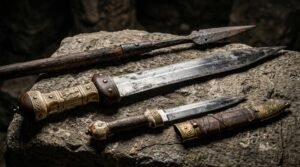
The Pilum Throw: Just before the lines clashed, the first two lines hurled their heavy javelins, the Pila. These were brilliantly designed: the long, thin iron point bent on impact in the enemy’s shield, making it useless and unwieldy. Even if the pilum did not kill, it effectively disarmed the opponent.
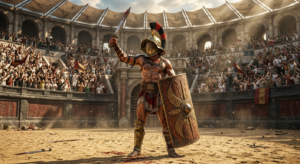
Close Combat: Immediately after the throw, the legionaries drew their short sword, the Gladius, and advanced. Protected behind their great tower shield (Scutum), they formed a wall of wood and steel. Fighting was not done through wild slashing, but through precise, short thrusts from behind the shield’s cover into the belly or face of the opponent. Efficient, energy-conserving, and absolutely lethal.
Rotation: This was perhaps the greatest advantage. While the “barbarians” fought to the point of complete exhaustion, the centurions could systematically replace their frontmost ranks with fresh men from the line behind. The enemy constantly found himself facing a rested, disciplined opponent.
Daily Life: Sweat, Bread, and Camaraderie
A legionary’s life consisted of fighting for only a small fraction of the time. The rest was hard, relentless work.
Training (Exercitium): Daily marches in full kit (approximately 30 kg), weapons drills, swimming, fortification building. Roman legionaries were not only soldiers; they were also the finest engineers, road-builders, and craftsmen of their age. A legion could build a bridge across a river while another defended it.
Diet: The staple was grain. Every legionary received a daily ration which he processed himself into porridge or flatbread. This was supplemented with some cheese, vegetables, and sour wine (Posca). Meat was rare and a reward.
Discipline and Pay: Discipline was iron-hard. Disobedience was punished with the centurion’s staff; cowardice with decimation (the killing of every tenth man in a unit). On the other side stood regular pay, the chance of plunder, and after 25 years of service an honourable discharge with a plot of land or a considerable sum of money.
The Roman legion was successful because every man knew his precise role. From the ordinary legionary in his contubernium to the legate – it was a system built on trust, merciless routine, and an unshakeable belief in the superiority of Rome.
Experience the Legion Up Close!
If you want not merely to read about it but to feel what it was like to march in a legionary’s sandals, to smell the sweat and the blood and to go into battle for the eagle, then I warmly invite you to discover my novels.
In In the Shadow of the Eagle, you follow Tribune Maximus and his centurion Brutus through the dark forests of Britain, where tactics and courage decide between life and death.
What fascinates you most about the Roman legion? The iron discipline, the sophisticated tactics, or the personal stories of the men? Feel free to send me a message – I look forward to the exchange.
Frequently Asked Questions about Roman Legion Combat
What was the secret strength of a Roman Legion?
Discipline, training, and formation – not individual warriors. The testudo formation, the manipular system, and coordinated use of heavy and light infantry made the legion the dominant fighting force of its age – on suitable terrain.
How heavy was a legionary’s equipment?
Up to 40 kilograms: armour, scutum, pilum, gladius, marching pack, and camp construction tools. Carried over daily distances of up to 30 kilometres. In Marc’s Eagle Saga, this physical reality is ever-present.
Why did legions sometimes lose against seemingly weaker opponents?
Because their formation became useless in the wrong terrain. In forests, swamps, or ambushes, legions completely lost their tactical advantage. The Teutoburg Forest is the most famous example – terrain and surprise neutralised all of Rome’s advantages in three days.

Continue reading

Enjoyed the article?
Dive even deeper into the world of the Romans – with Marc Beuster’s historical adventure novels.
What do you think? I’d love to hear your thoughts – feel free to share them in the comments!