Mist, Druids and Eagles: Britain against Rome – The True Story of a Brutal Conquest
Discover the true reasons behind the Roman invasion of Britain in AD 43. This article examines the political motives of Emperor Claudius, the strategic significance of the island, and the bitter resistance of the British tribes, including Boudica’s revolt. Essential reading for all fans of Roman history and the perfect historical background for the opening of my Eagle Saga with Volume 1, “In the Shadow of the Eagle”.
Marc Beuster
7/28/2025
4 min read
Mist, Druids and Eagles: Britain against Rome – The True Story of a Brutal Conquest
Few places in the Roman imagination were so shrouded in myth and fear as Britain. A mist-veiled island at the edge of the known world, inhabited by fierce, blue-painted warriors, ruled by mysterious druids who performed dark rituals in sacred groves. Even Julius Caesar had twice, in 55 and 54 BC, attempted to gain a foothold here, and had more or less failed.
Almost a century later, in AD 43, Rome made a new attempt. But what drove the most powerful empire in the world to send thousands of soldiers across the treacherous ocean to conquer this rugged land? The answer is, as so often in history, an explosive mixture of political ambition, greed, and strategic necessity.
As an author of historical novels, the struggle for Britain is one of my favourite settings. It is a stage on which the ordered, disciplined world of Rome collided head-on with the untamed, archaic culture of the British tribes. A brutal cultural clash that set the scene for incredible stories of courage, betrayal, and the will to survive.
Why Britain? The True Motives Behind the Invasion
Official Roman propaganda spoke of civilising the barbarians. The truth was considerably more prosaic.
Political calculation: The emperor who ordered the invasion was Claudius. He was regarded as weak, stuttered, and had long not been taken seriously by the Roman elite. He had come to power through a palace conspiracy and urgently needed a great military victory to legitimise his rule. A triumph over the mystical Britain, at which even the great Caesar had failed, would be the perfect coup.
Wealth and resources: Britain was rich. The Romans knew of tin deposits (indispensable for bronze production), lead, iron, and rumours of gold and silver. Even more important were agricultural lands for grain and, as cynical as it sounds, an inexhaustible source of slaves. Empires need resources, and Britain was a promising, untapped reservoir.
Strategic security: The island was a thorn in Rome’s side. It served as a refuge for Gallic rebels and was the spiritual centre of Druidism. The Druids stoked resistance against Rome in Gaul and embodied everything the Romans despised: uncontrollable religious power and anti-Roman ideology. To pacify Gaul once and for all, the source of resistance in Britain had to be cut off.
The Invasion of AD 43: Rome’s Iron Fist Meets Resistance
Under the command of the capable general Aulus Plautius, four legions – around 40,000 men – landed on the coast of Kent. Yet the beginning was anything but glorious. The legionaries, accustomed to fighting on the continent, feared crossing the ocean, which they regarded as an eerie boundary to the underworld. It took all the persuasive power of their officers to get them on board the ships at all.
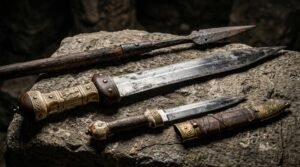
The British tribes, led by the brothers Caratacus and Togodumnus, relied on guerrilla tactics. They used their knowledge of the boggy, heavily forested terrain to lure the Romans into ambushes. But they had nothing to counter Rome’s disciplined war machine on open ground. In decisive engagements, such as the battle at the River Medway, Roman tactics prevailed: the targeted use of Pila, the unshakeable shield wall, and the lethal efficiency of the Gladius crushed the fierce but uncoordinated charge of the Britons.
Within a few years the Romans had conquered the south-east of England. Emperor Claudius even travelled out in person to claim the final victory at Camulodunum (modern Colchester) for himself – a perfectly staged performance, complete with war elephants to shock the locals and impress the troops.
A Land in Uproar: Boudica’s Bloody Rebellion
Rome believed Britain had been pacified. A fatal error. Roman rule was arrogant and brutal. Lands were confiscated, tribes humiliated, and heavy taxes levied. This powder keg exploded in AD 60/61.
On the death of the king of the Iceni, Prasutagus, Rome ignored his final wishes and annexed the kingdom. His widow, Queen Boudica, was publicly flogged and her daughters raped. It was the ultimate humiliation – and the spark that ignited a conflagration of hatred.
At the head of a vast tribal army, Boudica blazed a trail of devastation through the young province. The Roman cities of Camulodunum, Londinium (London), and Verulamium (St Albans) were burned to the ground, their inhabitants – Romans and Rome-friendly Britons – slaughtered without mercy. Archaeologists today still find thick red burn layers beneath the streets of London dating from this period.
The Roman governor, Suetonius Paulinus, who had been conducting a campaign in Wales, hastened back. In the decisive battle at Watling Street, he faced Boudica’s vast but undisciplined army with just 10,000 legionaries. Here again Roman superiority asserted itself: in a narrow defile where the sheer mass of the Britons was rendered ineffective, the Romans inflicted a terrible slaughter. Boudica’s rebellion drowned in blood.
Although the revolt was crushed, it had taught Rome one lesson: Britain would never be easy to govern. The conquest of the north took decades, and Scotland was never truly subjugated, which ultimately led to the construction of Hadrian’s Wall – a stone admission that the power of Rome had its limits.
Where History Becomes Adventure
The struggle for Britain is the perfect canvas for stories of honour, revenge, and the clash of worlds. It is the story of Roman centurions fighting for survival far from home in a cold, hostile land, and of Celtic warriors who risk everything for their freedom.
If you want to feel the chill of the British mist on your skin and hear the clash of Roman steel against Celtic shields, I invite you to immerse yourself in my novels. In my books, the Eagle Saga, my heroes Maximus and Brutus fight at exactly this unrelenting frontier of the Empire.
What fascinates you most about this era? The indomitable Boudica, the disciplined legions, or the mysterious Druids? Feel free to share your thoughts in a message to me!
Frequently Asked Questions about Rome’s Conquest of Britain
When did the Romans begin the conquest of Britain?
The permanent invasion began in 43 AD under Emperor Claudius – the starting point of the Eagle Saga – Sons of Rome. Caesar conducted expeditions in 55 and 54 BC but left no permanent occupation.
Who offered the strongest resistance to the Romans in Britain?
Caratacus led nine years of guerrilla warfare. Boudicca, queen of the Iceni, destroyed Londinium, Camulodunum, and Verulamium in 60/61 AD before being defeated. Both figures embody the stubborn resistance of the Britons.
Why did the Romans never fully conquer Ireland and northern Scotland?
The effort wasn’t worth the reward. No network of towns, no rich resources, no controllable hinterland. Rome was pragmatic: no conquest without economic benefit.

Continue reading


Enjoyed the article?
Dive even deeper into the world of the Romans – with Marc Beuster’s historical adventure novels.
What do you think? I’d love to hear your thoughts – feel free to share them in the comments!