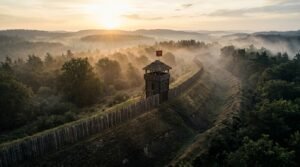
Imagine standing on a misty morning in northern England. In front of you stretches a ditch, and beyond it a wall of dressed limestone blocks – not just chest-high, but nearly five metres tall, topped with battlements, watchtowers, and a garrison that has been stationed here for years. Far from home. Far from everything they know.
That is Hadrian’s Wall. And it is so much more than a tourist attraction in northern England.
Hadrian’s Wall: More Than a Wall
Emperor Hadrian ordered its construction in 122 AD – running the entire width of Britain, from the Irish Sea to the North Sea. Almost 120 kilometres long. A gigantic undertaking, conceived not in years but in decades.
But why?
The simple answer: protection against the tribes of the north, the Caledonians and Picts, who stubbornly resisted Roman rule. But that answer falls short.
Hadrian’s Wall was not a purely defensive structure. It was a checkpoint. A customs gate. A statement.
A Border as Political Signal of Roman Power
Anyone who wanted to cross the Wall – traders, nomads, tribal warriors with peaceful intentions – had to pass through one of the milecastles. There sat soldiers who checked, recorded, taxed. The Wall didn’t simply separate two worlds. It regulated the traffic between them.
At the same time, it sent an unmistakable message in every direction: Here Rome ends. Here chaos begins. And we decide who goes where.
For the legionaries stationed here, that meant a daily life caught between routine and constant threat. Small forts every few kilometres, watchtowers within sight of each other, patrols in every kind of weather. In winter, snow fell on armour designed for a Mediterranean climate. In summer, Atlantic winds lashed the bare hilltops.
Who Held Hadrian’s Wall?
A common image shows the Wall manned by Italian legionaries. The reality was far more complex.
The troops who guarded Hadrian’s Wall came from across the empire: Syrians, Gauls, Pannonians, Thracians. Inscriptions found along the Wall record prayers to gods no one in Rome had ever heard of. Soldiers posted thousands of kilometres from their homelands to a wind-battered outpost at the edge of the known world – and who stayed for decades, married, had children, died.
That is the story that grips me. Not the grand politics in Rome. But the individual human being at the edge of the world.
What Hadrian’s Wall Still Tells Us Today
Archaeologists have uncovered finds along the Wall that bring everyday life vividly back: writing tablets with personal messages, petitions to officers, evidence of trade with the tribes north of the border. The Wall was not a hermetically sealed front line. It breathed, it lived, it traded.
And that is precisely what makes it so fascinating – for historians, archaeologists, and yes: for novelists.
Why This World Never Lets Me Go
I write historical adventure novels set in this world – but not in the era of the Wall. My stories are set earlier, in the turbulent decades of the Roman conquest of Britain. In a time when it was far from certain whether Rome would ever truly gain a foothold on this island.
Hadrian’s Wall is the product of that era. Without the men who fought in Britain a century before – who fought, doubted, and stayed anyway – that Wall would never have existed. For me, it stands like a full stop at the end of a story I tell from the very beginning.
If this world captivates you, my Eagles of Rome series might be exactly what you’re looking for.
Frequently Asked Questions about Hadrian’s Wall
How long is Hadrian’s Wall?
Hadrian’s Wall stretches approximately 118 kilometres (73 miles) across northern England – from the Irish Sea in the west to the North Sea in the east. It is one of the best-preserved military structures of antiquity and has been a UNESCO World Heritage Site since 1987.
When and why was Hadrian’s Wall built?
Construction began in 122 AD on the orders of Emperor Hadrian. The Wall served not only as a defensive line against northern tribes but primarily as a control point for the movement of people and goods – a key instrument of Roman power politics at the empire’s frontier.
Which soldiers guarded Hadrian’s Wall?
Contrary to popular belief, the garrisons were not made up of Roman legionaries alone. Auxiliary soldiers from across the empire served there: Syrians, Gauls, Thracians, Pannonians. Inscription finds show that these men brought their own gods, languages, and cultures to the edge of the Roman world.
Is Hadrian’s Wall still preserved today?
Yes – large sections remain visible today, particularly in the sparsely populated central zone of northern England. The Hadrian’s Wall Path, a walking route following its entire length, is one of Britain’s most popular long-distance trails. Several forts, including Housesteads and Chesters, are open as museums.
What does Hadrian’s Wall have to do with Marc’s books?
Marc’s Eagles of Rome series is set in the era of the Roman conquest of Britain – the period that made Hadrian’s Wall possible in the first place. Without the legionaries of the 1st century AD, that Wall would never have been built. The books tell the story that came before.
Continue reading

Enjoyed the article?
Dive even deeper into the world of the Romans – with Marc Beuster’s historical adventure novels.
What do you think? I’d love to hear your thoughts – feel free to share them in the comments!